English Kindergarten in Korea
Play-Based vs. Academic English Kindergarten: Curriculum Intensity, Homework and Age-Appropriateness
We moved our daughter from play-based to a reading-focused academic program, then back again. Here’s what genuinely changed each time — the good and the cost.
We didn’t plan this as an experiment, but that’s effectively what it became. Our daughter went from a more play-based English kindergarten, to a more academically structured, reading-focused one, and then back to play-based again. Each move taught us something we hadn’t expected.
There’s no single right answer between play-based and academic programs — each came with real, specific trade-offs for our family. The academic program built reading habit and task-completion practice. It also came with a homework load heavy enough to noticeably shrink our after-school family time. Which one suits your child depends on what you’re optimizing for, not on which philosophy sounds more serious.
What the Academic Program Actually Gave Us
When our daughter moved into the more reading-focused, academically structured program, we noticed real benefits fairly quickly. She read more — not because she suddenly loved reading more, but because reading was a required, structured part of her day, and that repetition built genuine capability. She also developed more practice simply sitting down and completing an assigned task from start to finish, which isn’t nothing at that age.
These aren’t small things. If your priority is building early reading fluency and the discipline of finishing assigned work, a program like this can genuinely deliver that.

What the Homework Actually Was
The trade-off showed up at home, not at school. The homework load was real, and broken down, the components we experienced included:
- Tablet-based review exercises
- Assigned books and reading
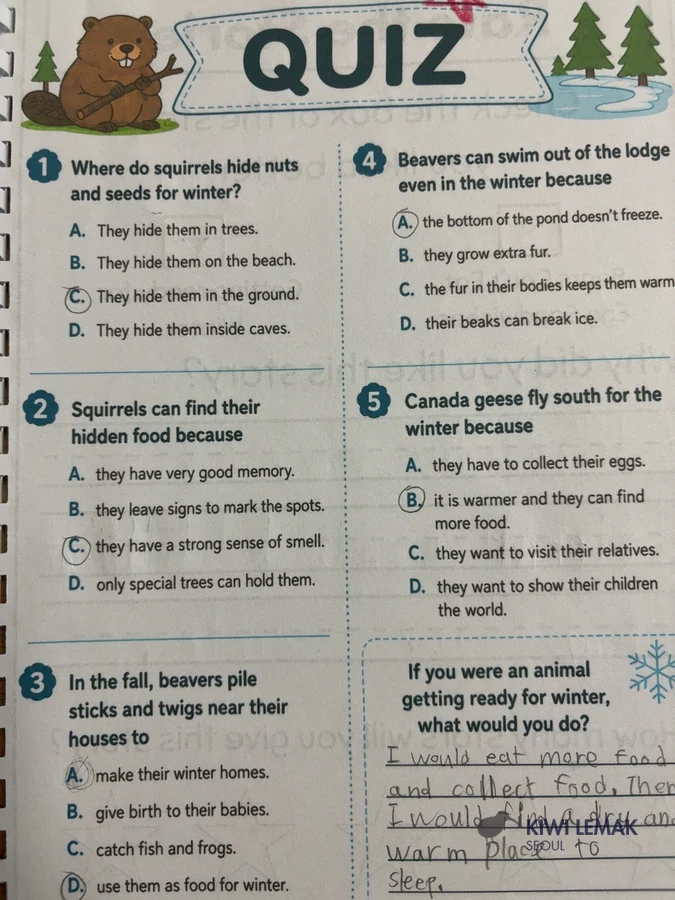
- Quizzes tied to what had been covered in class
- Writing tasks
- Reading-related testing (SR/assessment-style work)
None of these, taken individually, sounds unreasonable for a structured academic program. The effect showed up cumulatively, not in any single component — a completed phonics worksheet here, a spelling test there, night after night.
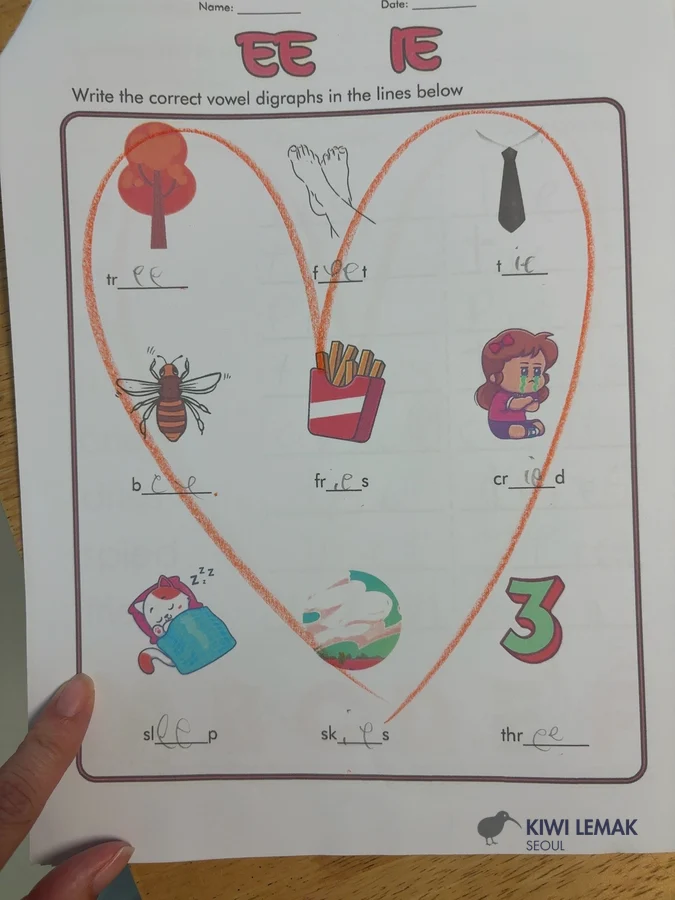
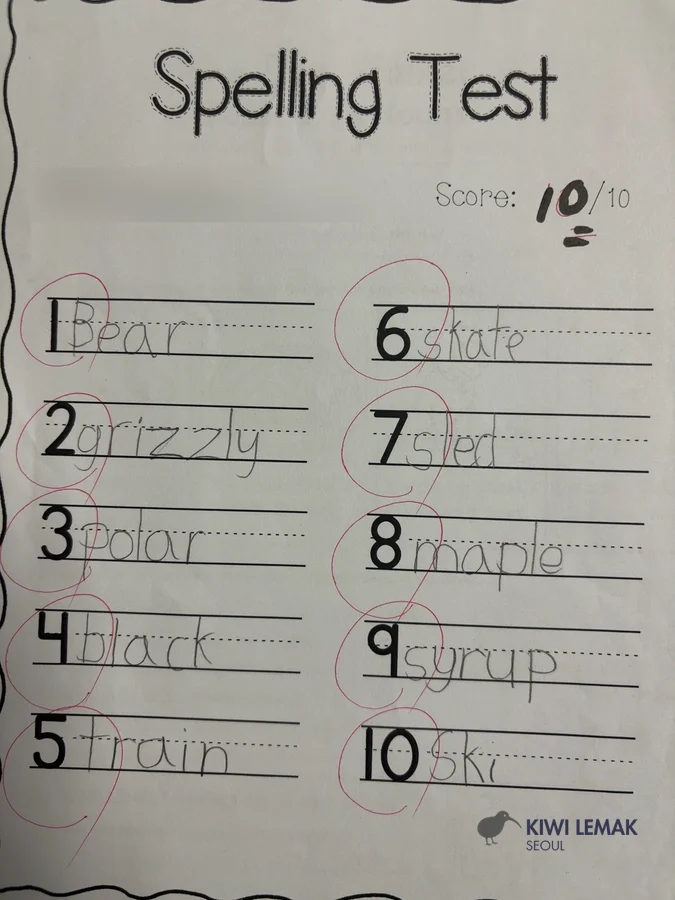
A real completed phonics worksheet, and a real completed spelling test — perfect score, name redacted.
What It Cost Us
The real cost wasn’t the homework itself — it was what it displaced. We noticed the time available after school for talking together, playing, reading together voluntarily (as opposed to assigned reading), and just ordinary unstructured family time shrinking. It wasn’t dramatic or sudden. It was a gradual squeeze, night after night, until we noticed how little of the evening was left for things that weren’t on a list.
What Changed When We Went Back to Play-Based
After returning to a more play-based program, we noticed something specific: more spontaneous conversation about what our daughter had learned during the day. Not homework-prompted conversation — the kind that comes up naturally, unprompted, because there’s actual time and energy left over for it. She’d come home wanting to talk about something from school. Canadian animals came up once, and she asked me, completely out of nowhere, whether I knew what a toucan was.
That’s obviously not proof that play-based programs universally produce more curious kids. It’s what we noticed, in our own house, once the evening stopped being consumed by required tasks.
Is a Program Simply “Too Academic”?
This question doesn’t have one answer — it depends heavily on the specific program and the specific child. In the more academically structured, reading-focused program our daughter attended, intensity showed up as textbook-heavy mornings, the homework load above, and reading-related testing. In the current, more play-based program, the day includes writing and topic-based learning too, but the individual lesson blocks don’t run especially long, and there’s more built-in play time.
Neither of these is automatically “too much” or “just right” — they’re two different points on a spectrum, and where your own child sits on that spectrum matters more than which program you’re comparing them against in the abstract.
Rather than a checklist claiming to diagnose a child, here’s what we’d actually watch for as parents:
- Whether your child can sit through the assigned lesson blocks without visible strain, versus being pushed well past what feels sustainable for their age
- How much unstructured play time exists inside the actual school day, not just before or after it
- Whether homework is consuming most of the evening, most nights
- Whether your child still seems curious and willing to talk about school, versus depleted by the end of the day
We’re not diagnosing child development here. Ministry of Education discussion has raised concerns about testing, ranking, and drill-based instruction in this category — we can’t say how many programs actually match those specific concerns, only that the concerns exist at a policy level. That’s exactly why it’s worth checking a specific program directly, rather than assuming either way.
So Which Is Better?
It depends on what you’re trying to build. If reading fluency and task discipline are your priority, and your child (and your family’s evening schedule) can absorb a real homework load without it crowding out everything else, an academic program can genuinely deliver on that. If unstructured time, spontaneous curiosity, and family bandwidth in the evenings matter more to you right now, a play-based program protects that in a way the academic one didn’t for us.
We’re not telling you play-based is the right answer. We tried both, deliberately, and ended up back at play-based — but that reflects our family’s priorities at this particular stage, not a verdict on academic programs generally. If you want to see what an actual day looks like, hour by hour, under each type of program, we walk through what a real day looks like at each program, separately.
What We’d Ask Before Choosing Either
- What does the actual nightly and weekly homework load look like — not the marketing description, the real one?
- How much unstructured play time exists inside the school day itself?
- What happens to your family’s evenings once the homework starts?
- Is your child, right now, someone who thrives with more structure, or someone who needs more room to breathe?
Over to You
Play-based or academic? We’ve paid for both. I’d ask about Tuesday night before choosing a side.