Author: little.giants.nicky@gmail.com

  • Do I Get to Choose My Ring Today?

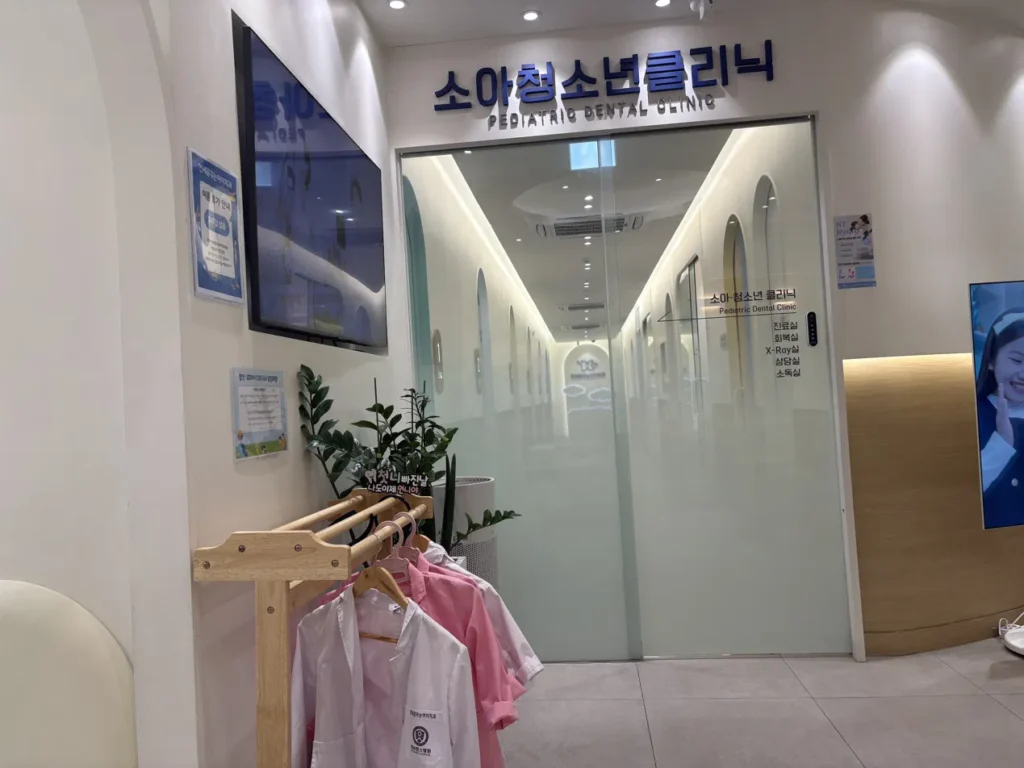
    We braced for tears. Instead, our daughter walked in excited — because she’d heard that kids get to choose a little ring after their check-up. Here’s what her first visit to Yonsei Dreaming Child Dental Clinic (연세꿈꾸는아이치과) actually looked like.

    ✓ Quick Answer

    Yes — Korean pediatric dentists are known for being very child-friendly. Our visit included an X-ray, check-up, and fluoride treatment, and cost 34,000 Korean Won in total.

    A cartoon plays on the ceiling screen the moment you lie back in the chair.

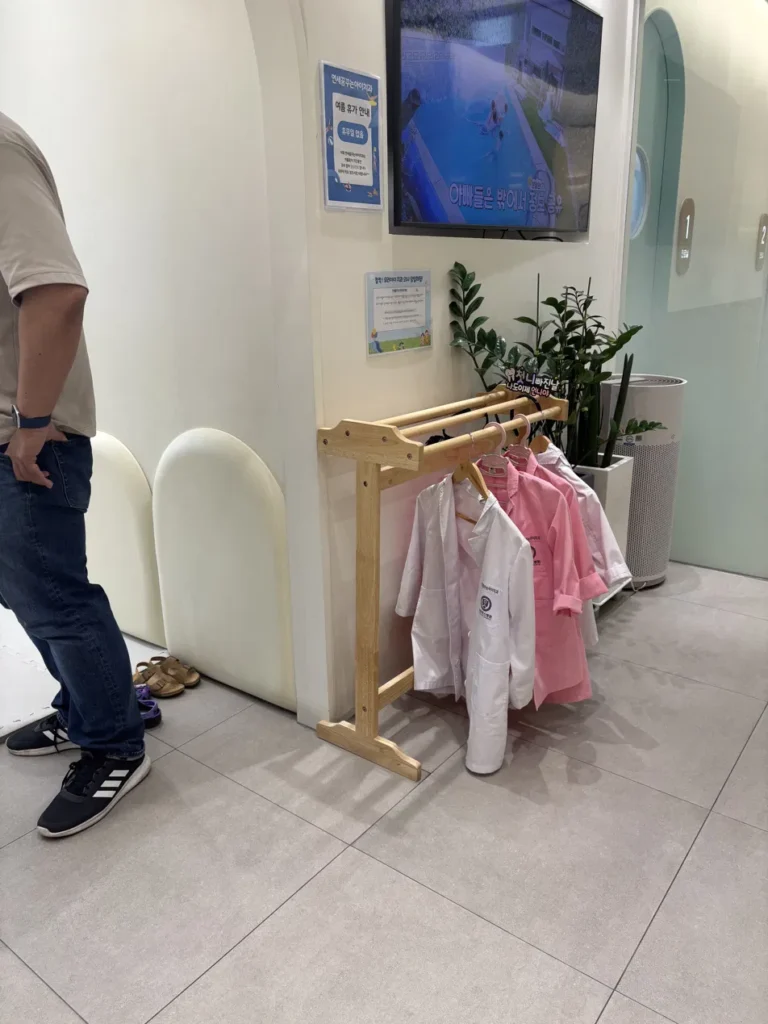
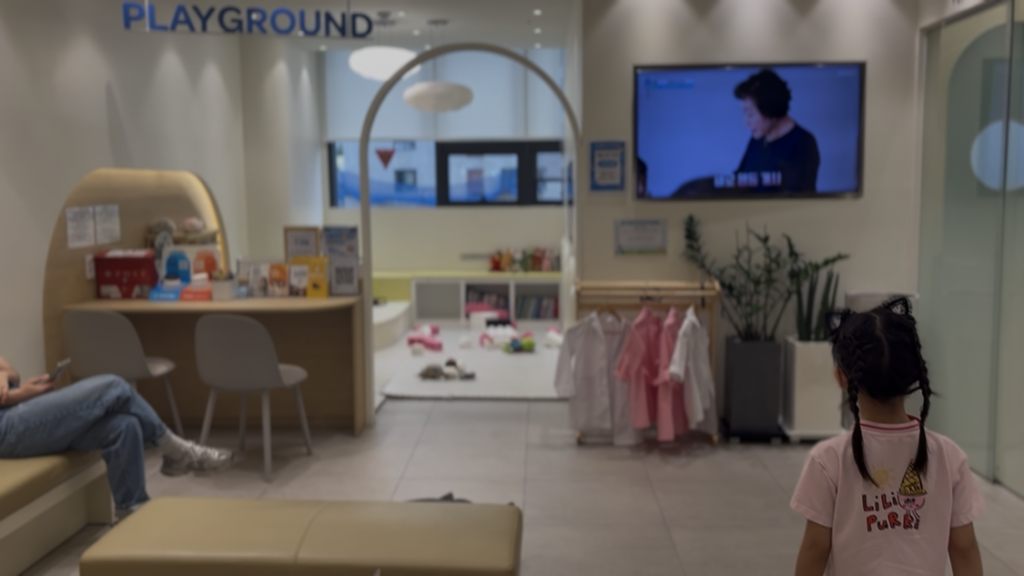
    The clinic was quiet, bright, and clearly designed for children — not adults. Past the reception desk is an entire playground room: cushioned yellow benches, a shelf of picture books, foam building blocks scattered across the floor, stuffed animals lined up along the window ledge, and a green Lego-style baseplate where our daughter lined up a zebra, a penguin, and a rabbit before her name was even called. There’s even a miniature dentist’s coat kids can try on before their turn — she picked pink and refused to take it off even after we left. For a few minutes, she wasn’t a patient at all. She was simply pretending to be a dentist herself.

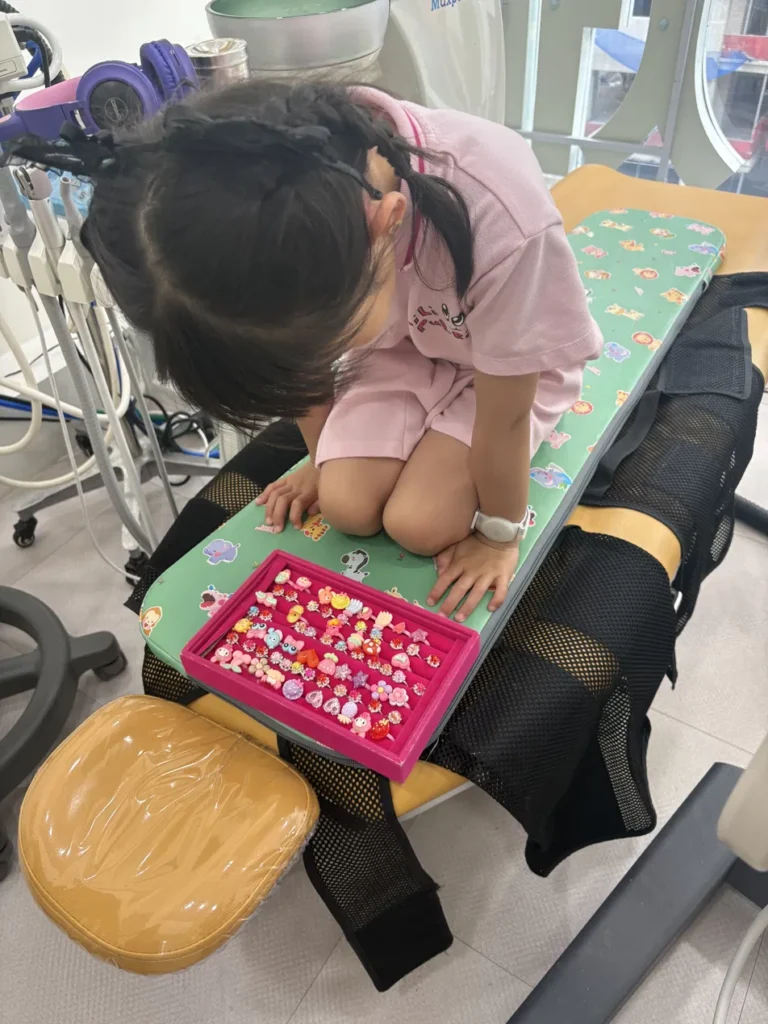
    Once in the chair, headphones went on and a show started overhead — she didn’t flinch through the whole check-up. When it was over, she didn’t remember the treatment at all. She remembered the little ring.

    Andrew’s Note

    What surprised me most wasn’t the equipment. It was how naturally the staff knew exactly how to help a nervous kid feel comfortable — like they’d refined every small detail specifically for this.

    — Andrew

    The reward box — every child leaves with something small to choose. Dozens of tiny rings: cartoon animals, fruit shapes, glittery stones — she went through nearly all of them before deciding.

    Korean Mum’s Note

    When I was little, going to the dentist felt completely different. My mum would say, “I’ll count to three before I pull it,” and then open the door at two. Visits today feel so much gentler.

    — Korean Mum

    Practical Tips

    • Search “어린이 치과” on Naver to find clinics built specifically for kids.
    • Book a morning appointment — shorter waiting times, calmer kids.
    • Bring your insurance card; most visits are partly covered.
    • Most clinics have some English support, even if just translation apps.

    FAQ

    Are pediatric dentists common in Korea?
    Yes — most neighborhoods have at least one clinic that specializes in children, often recognizable by playful signage or characters out front.

    Can foreigners use these clinics without issue?
    Generally yes. Larger clinics near international schools often have staff comfortable with English.

    How often should young children visit the dentist?
    Most pediatric dentists here recommend a check-up every six months, similar to Western guidelines.

    Related Articles

    • What Surprised Us About Korean Kindergarten
    • Why Every Apartment Here Has CCTV in the Elevator
    • Andrew’s Kimchi-Jjigae, Reviewed by a Korean Wife

    Has your child been to the dentist here yet — and did they get a ring too?
  • My Malaysian-Kiwi Husband Makes Kimchi-Jjigae Better Than Actual Koreans (I Said What I Said)

    Eat & Explore  /  Cooking

    My Malaysian-Kiwi Husband Makes Kimchi-Jjigae Better Than Actual Koreans (I Said What I Said)

    🏆 world’s best
    kimchi-jjigae*

    *according to one extremely biased Korean wife

    I’ve eaten kimchi-jjigae my entire life. My husband has been in Korea for a fraction of that. And yet — somehow — I’m the one asking for seconds now.

    “I’m Korean. I have eaten kimchi-jjigae approximately ten thousand times. And my Malaysian-Kiwi husband’s version is, unfortunately for my national pride, better than most restaurants near us.” — Nicky

    🥘 what you’ll need
    • Well-fermented kimchi, with juice ★
    • Pork belly, sliced
    • Firm tofu, cubed
    • Kimchi brine, 2 tbsp
    • Green onion, chopped
    • Gochugaru (chili flakes) ★
    • Garlic, minced
    • A pinch of sugar (Andrew’s addition)
    ★ Can’t find these where you live? No well-fermented kimchi — let store-bought kimchi sit at room temperature for 2–3 days, or add a splash of rice vinegar. No gochugaru — regular chili flakes work in a pinch, though the color and smokiness won’t be quite the same.

    Let me set the scene properly, because this is the kind of claim that requires context, or my mother will never forgive me for writing it. I grew up on kimchi-jjigae. I have opinions about kimchi-jjigae the way other people have opinions about their hometown pizza place. And somehow, my husband — a man who six months ago thought all Korean stews were basically the same soup in different colors — has quietly become the better cook in this kitchen.

    This was not supposed to happen. Here’s how it did.

    1

    He started from a position of total confidence and zero skill

    신김치 · Step 1

    STEP 1 — 잘 익은 신김치 준비

    A
    Andrew

    “I used fresh kimchi. Turns out that’s the opposite of what you want.”

    Andrew’s first kimchi-jjigae was, and I want to be diplomatic here, a war crime. He used fresh, mild kimchi instead of the properly sour, aged stuff, then panicked about flavor and dumped in extra soy sauce like he was seasoning a Malaysian curry.

    ⚠ where I went wrong

    “I added a full extra round of soy sauce and salt on top, assuming it needed more like a Malaysian curry base would. Don’t do this — the kimchi already carries all the salt and fermented flavor you need.” — Andrew

    “It wasn’t bad because it was foreign. It was bad because it was salty enough to preserve a body.”
    — me, being far too honest, attempt #1
    2

    Then he did the one thing most people never do — he actually listened

    Most people, when their cooking gets roasted, get defensive or give up. Andrew asked follow-up questions like he was debugging a spreadsheet. Why sour kimchi and not fresh? Why does the brine matter more than soy sauce? He treated my grandmother’s instincts like a technical spec sheet to reverse-engineer, and honestly, that’s when I should have known I was in trouble.

    3

    The version that broke me

    삼겹살 볶기 · Step 2

    STEP 2 — 삼겹살 먼저 볶아서 기름 내기

    N
    Nicky

    “This is the part where the kitchen starts smelling like heaven.”

    Well-fermented kimchi with all its juice, pork belly rendered first so the fat carries the flavor, a splash of kimchi brine instead of extra salt, tofu added dead last so it doesn’t fall apart into sad little clouds. No seasoning until the final taste test. It sounds like nothing. It tastes like he’s been doing this for twenty years, not twenty weeks.

    The ttukbaegi stone pot that started it all

    Bought half as a joke, now used weekly. It keeps everything bubbling at the table exactly like the restaurants do.

    See it

    👩‍🍳 Andrew’s mom’s tip

    “Never trust a stew that’s salty on its own — the salt should come from what you cooked, not what you added.” She taught him that with Malay curries. It saved his kimchi-jjigae too.

    4

    The unforgivable Malaysian twist that I now defend to the death

    He adds a small pinch of sugar right at the end. This is, technically, not traditional. I told him so, several times, with increasing volume. He kept doing it anyway, because apparently balancing sour and spicy with a touch of sweetness is just how he was raised to think about flavor. I now ask for extra rice specifically because of it. I have not told my mother about the sugar. I am not going to.

    malaysia
    Assam pedas

    Sour-spicy balance from tamarind, sweetness used sparingly.

    cantonese
    Sour plum stews

    Aged, fermented ingredients always preferred over fresh.

    korea
    Kimchi-jjigae

    Fermentation does the seasoning work on its own.

    The actual lesson here, if there is one

    He wasn’t trying to make it “authentic.” He was trying to make it good, using someone else’s grandmother’s logic filtered through his own palate, and refusing to be embarrassed about the parts that didn’t fit the rules. Turns out that’s a pretty solid life philosophy for a multicultural household in general.

    Anyway. He’s making it again this Friday. I’ve already told three neighbors. This is now, apparently, a whole thing.

    Approved by
    a Korean wife
    — Nicky’s final verdict

    This post contains affiliate links. If you buy something through them, we may earn a small commission at no extra cost to you.

    Nicky

    English academy director in Gimpo, lifelong kimchi-jjigae connoisseur, recently and reluctantly proven wrong in her own kitchen.

  • Is Korea Really as Safe as Everyone Says?

    Real Talk · Safety & Culture

    We live in an apartment — the most common type of housing in Korea. As a dad, my first real question wasn’t about the apartment itself. It was about my daughter.

    “Korea is one of the safest countries in the world” is something you hear constantly before moving here. I believed it in theory. But once we actually settled in and our daughter was old enough to want to go to the playground on her own, that phrase stopped being an abstract fact and became a real question I needed to answer for myself: how safe, exactly, and safe for who?

    As a foreigner, I couldn’t fall back on the instincts I’d have back home — a “feel” for which streets are fine and which aren’t, or word-of-mouth from a lifetime of local knowledge. I needed something more concrete. So I started with the one thing I could actually count: CCTV.

    Why CCTV, of all things?

    It’s not that cameras alone make a place safe. But they’re one of the few genuinely objective things I could check myself, without needing to trust a stranger’s opinion or a statistic I couldn’t verify. If something happened to my daughter at the playground, in the elevator, or on the walk between our door and the front gate — would there actually be a record? Would help come? Those were the real questions underneath “is it safe.”

    So over a weekend, I walked our entire complex — the building entrance, every hallway, the elevators, the underground parking, and the playground — and simply counted.

    [PHOTO 1 — Building entrance with visible CCTV camera]

    What I actually found

    Every hallway corner had one. Every elevator bank had at least one, usually facing the doors directly. The underground parking garage had cameras spaced every few pillars. And the playground — the place I was most worried about — had multiple angles covering it, not just one camera facing one direction.

    [PHOTO 2 — Hallway camera]   [PHOTO 3 — Elevator camera]

    Korea has one of the highest CCTV densities per capita in the world, and apartment complexes like ours are a big part of why. It’s not just public cameras on street corners — it’s built into private residential life at a level I hadn’t seen anywhere we’d lived before.

    [PHOTO 4 — Underground parking camera]   [PHOTO 5 — Playground, wide shot showing camera coverage]

    The question that mattered more: who’s actually watching?

    Cameras only matter if someone can act on what they show. So I also looked into what happens on the other end — who monitors the footage, and how quickly.

    Our complex has a 24-hour security office near the main gate, staffed in shifts, with live monitors for the main entrances and the playground. When I asked directly what would happen if a child seemed to be in distress or approached by a stranger, the answer was straightforward: staff can be there within a few minutes, and footage is kept and reviewable for weeks if needed.

    [PHOTO 6 — Security office / guard booth near the entrance]

    That, more than the camera count itself, was what actually reassured me. A camera that nobody watches is just decoration. A camera connected to a real person who can respond is a genuinely different thing.

    So — can she play outside alone?

    This was the question I actually started with. Based on what I found, my honest answer is: earlier than I expected, and with more comfort than I expected. It’s common here to see quite young children walking to school or playing at the playground without an adult standing right next to them — something that would have made me nervous anywhere else we’ve lived. Seeing the camera coverage and the response system behind it helped me understand why that’s normal here, rather than something Korean parents are just more relaxed about by nature.

    [PHOTO 7 — Kids playing at the playground]

    That said, I’m not going to pretend there’s no trade-off. Knowing that so much of daily life is on camera took some getting used to, and it’s a fair question for anyone moving here to sit with. Some residents we’ve spoken to feel genuinely uneasy about it. I understand that reaction — I just landed somewhere different after actually checking for myself instead of going on the general reputation alone.

    [PHOTO 8 — Wide shot of the apartment complex]   [PHOTO 9 — Walking path between buildings]

    If you’re a parent moving here

    A few things I’d suggest checking before you assume anything, one way or the other:

    • Walk the complex yourself and actually look for cameras — don’t just take a listing’s word for it
    • Ask directly whether there’s a staffed security office and what their response process looks like
    • Talk to other parents in the building, if you can — they’ll know the specific playground and street patterns better than any general statistic

    [PHOTO 10 — Our daughter at the playground, from a comfortable distance]

    “Korea is safe” turned out to be true for us — but it wasn’t a feeling I could just borrow from other people. It’s something I had to go check myself, camera by camera. I’d genuinely recommend any parent moving here do the same.

    This post reflects our own experience at one apartment complex . Security staffing, camera coverage, and response times vary by building, management company, and city.