Category: Living in Korea

  • Korean Apartment Etiquette: What I Missed the First Time

    LIVING IN KOREA

    KOREAN APARTMENT LIVING

    You are viewing: Living in Korea → Korean Apartment Living → Korean Apartment Etiquette: What I Missed the First Time

    Korean Apartment Living

    Korean Apartment Etiquette: What I Missed the First Time

    A stranger in the elevator asked me what floor I was going to, and I had no idea why. The small courtesy I completely missed — and what apartment etiquette generally expects of you.

    I was in our apartment elevator holding our daughter, with a bag of shopping hanging off one arm, when a woman I didn’t know asked me what floor I was going to.

    She wasn’t being nosy about where I lived — she was offering to press the button for me because my hands were obviously full. I didn’t understand that in the moment, said nothing, and just pressed my own floor button. I only worked out what had actually happened afterwards, and it’s stayed with me as the clearest small example of a rule nobody hands you in writing.

    What Actually Happened

    I remember the moment clearly because of how wrong I got it. My arms were full, my daughter was on one hip, and a stranger asked me a direct question about which floor I was headed to. My first reaction was confusion — why did she need to know that? I didn’t answer. I just shuffled forward and pressed my own button, probably looking a bit awkward about it.

    It was only later that I understood what had actually happened: she’d seen someone with full hands and was offering to press the button for me, the way you might hold a door open for someone carrying too much. It wasn’t about my floor at all. It was about my hands being full.

    The button panel in one of our building’s elevators — the same kind of panel from that morning.

    Why I Missed It

    I hadn’t come across that particular courtesy before, so the question read to me as oddly personal rather than helpful. In hindsight it’s such a small, practical kindness — the sort of thing that only stands out because I didn’t have the context for it yet.

    If someone in a Korean apartment elevator asks what floor you’re going to while your hands are full, they’re very likely offering to press it for you, not asking out of curiosity. A simple floor number back, or a quick “thank you,” covers it. Now when I see someone getting into the elevator with their hands full — shopping, a stroller, a kid on one hip — I ask the same question myself.

    The Wider Pattern

    Most of what I’d now call apartment etiquette here has come to me the same way — not from a posted rule, but from getting it wrong once and being quietly corrected or helped anyway. Holding a door, pressing a button, keeping hallway noise down late at night, not blocking a shared entrance with a stroller or delivery boxes: none of it is exotic, all of it is easy to miss the first time because nobody actually tells you in advance.

    The two etiquette questions that come up most for foreign residents — what’s expected around noise, and how rubbish and recycling actually work — are big enough that they get their own full answers elsewhere in this series rather than a rushed paragraph here.

    Over to You

    Watch for it once and you’ll never miss it again. That’s most of apartment etiquette, honestly.
  • Living in a Korean Apartment: What Surprised Us Most

    LIVING IN KOREA

    KOREAN APARTMENT LIVING

    You are viewing: Living in Korea → Korean Apartment Living → Living in a Korean Apartment: What Surprised Us Most

    Korean Apartment Living

    Living in a Korean Apartment: What Surprised Us Most

    From an elevator conversation I misunderstood to a toilet seat with more buttons than my car — the moments of Korean apartment life that actually caught me off guard, and what I’ve come to genuinely appreciate.

    I grew up in a detached house in New Zealand. I’ve now lived in a Korean apartment for years, and I still keep a mental list of the moments that caught me completely off guard.

    Korean apartment life surprised me in almost every direction — some of it annoyed me, some of it made me laugh, and a fair amount of it I’ve come to genuinely appreciate. This series is that list, one real moment at a time: an elevator conversation I misread, a rubbish bag system that frustrated me before it made sense, a toilet seat with more buttons than I knew what to do with, and a management office I judged too quickly.

    The Small Misunderstandings

    Some of the earliest surprises were just about not knowing the rules yet. I once stood in the elevator holding our daughter and a bag of shopping while a woman asked me what floor I was going to — and I had no idea why a stranger wanted to know where I lived. It turned out she was just offering to press the button for me, because my hands were obviously full. That one still makes me laugh at myself, and it’s a good enough story that it gets its own page later in this series.

    The Things That Actually Frustrated Me

    Rubbish took the longest to get used to. Where I grew up, you just had a bin. In Korea, you need the official pay-as-you-throw bags, and if you run out, you can’t take the rubbish out until someone goes and buys more. I found that genuinely annoying before I adjusted to just keeping a spare pack on hand. Food waste added another layer again — the first machine I saw for it weighed what you put in, which wasn’t something I’d ever thought about before.

    The Things I Didn’t Expect to Appreciate

    Then there’s the list of things I now quietly rely on. The heating in our apartment is far better than anything I grew up with. Parcels turn up at our door without us doing anything. There’s a bakery, a kimbap place, and a convenience store within an easy walk. I used to spend weekends mowing a lawn and repainting a fence — now I don’t have either.

    Zoom out further and the whole complex starts to feel like its own small neighbourhood rather than just a building. Staff patrol the property and manage parking. An intercom and an app handle who gets through the gate. Shops are close enough to reach on foot. None of that is any one dramatic thing — it’s the accumulation of a lot of small systems working quietly in the background that I didn’t expect when I moved in.

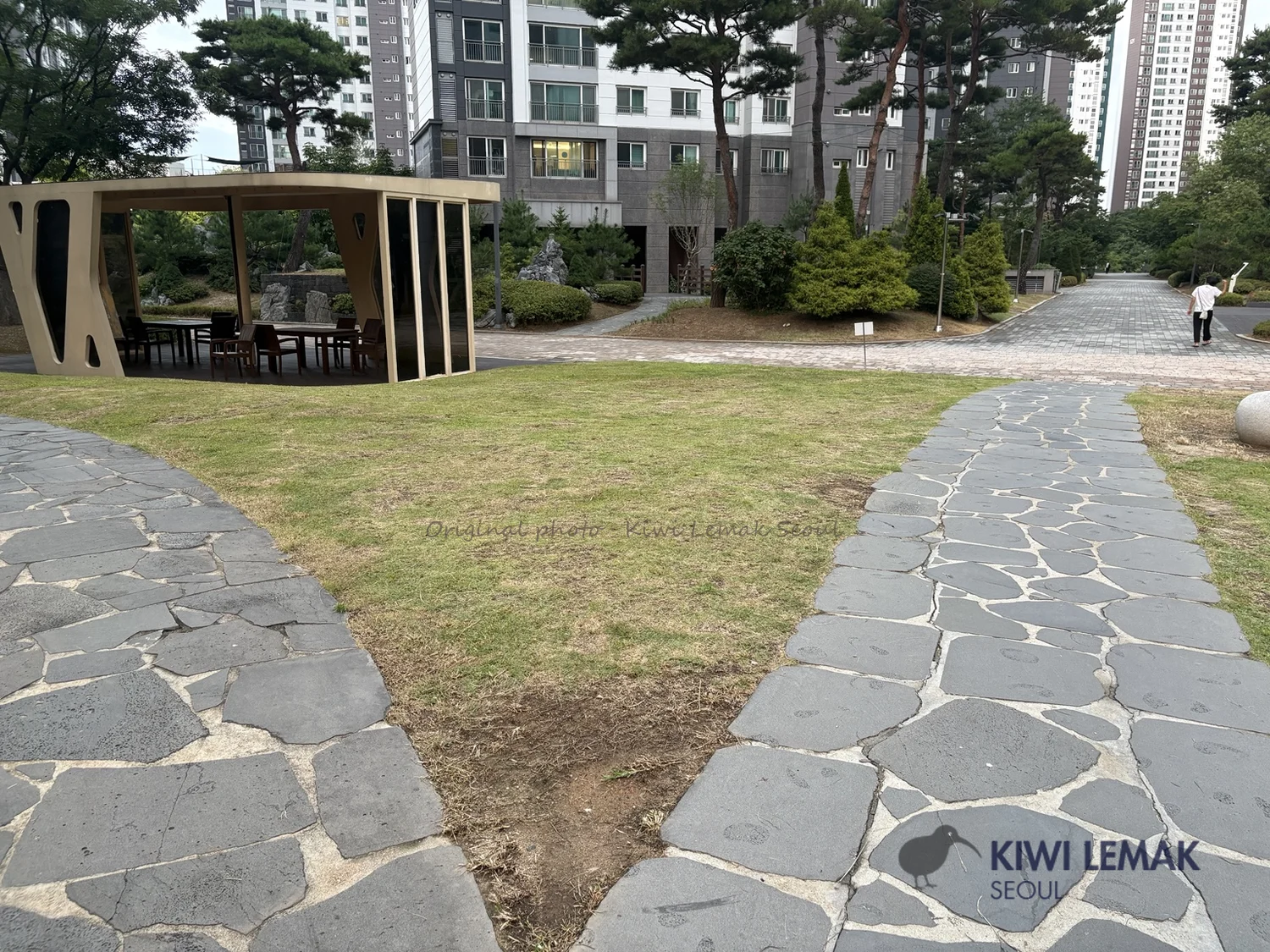
    The courtyard and the playground in our own complex — the kind of shared space that made it start to feel like a neighbourhood rather than just a building.

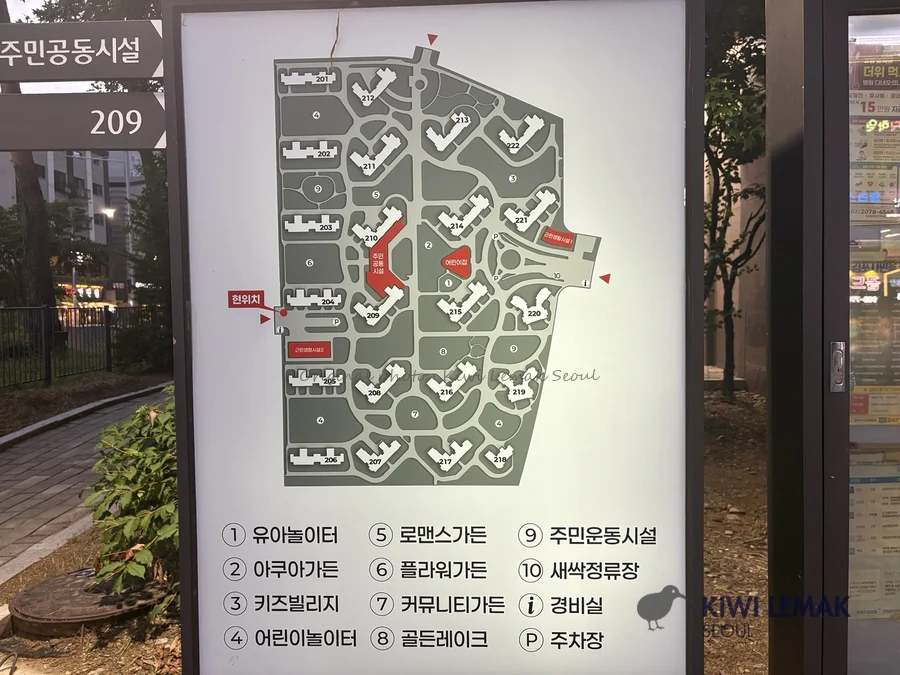
    The facility map posted in our complex — more buildings and amenities on one site than I expected when we first moved in.

    What This Doesn’t Make Perfect

    None of this makes Korean apartment life perfect, and I’m not trying to argue it’s simply better than a house. Floor noise, parking, and the paperwork at the management office all took real adjusting to, and I go into each of those honestly elsewhere in this series. But enough of it has become something I appreciate that I don’t think about the trade-off the way I did in the first year.

    What This Series Covers

    Start wherever your own question actually is — this isn’t a list you need to read in order. If it’s actually the address system you’re trying to make sense of — dong and ho numbers, and how Korean addresses work for navigation and delivery — that’s its own separate guide elsewhere on the site, not repeated here.

    Over to You

    For a long time, ours was simpler than any of this — was the place actually going to work for how we live. Everything else on this list is just the detail underneath that one question.

  • Food Waste in Korean Apartments: From RFID Scales to Our Food-Waste Processor

    LIVING IN KOREA

    KOREAN APARTMENT LIVING

    You are viewing: Living in Korea → Korean Apartment Living → Food Waste in Korean Apartments: From RFID Scales to Our Food-Waste Processor

    Korean Apartment Living

    Food Waste in Korean Apartments: From RFID Scales to Our Food-Waste Processor

    The first food-waste machine I encountered in Korea weighed what you threw away with a card. Years later, in a different building, we own a machine of our own that does something completely different.

    One of my earliest Korean apartment surprises had nothing to do with people — it was a machine that wanted to weigh my food scraps before it would let me throw them away.

    An early apartment I lived in used a food-waste disposal system where you scanned a card and the machine weighed what you put in, which was a completely unfamiliar idea to me. Our current apartment handles food waste differently, and we now own a household food-waste processor that dries it down before disposal. That difference is the actual point of this article: food-waste systems are not the same from one Korean building to the next, and I’d rather show you both of ours honestly than describe either one as the standard.

    The Weighing Machine, As I First Saw It

    I remember standing in front of that machine thinking it was strange that something as ordinary as food scraps needed to be weighed at all. Where I’d come from, food waste just went in with everything else, or at most into a separate bin without any measuring involved. Having a card-and-scale system attached to something so mundane was one of those small moments that reminded me I wasn’t dealing with rubbish the way I used to. That was one specific building’s setup, not something I’ve seen everywhere since.

    What We Do Now, In a Different Building

    We now own a food-waste processor at home. It dries and processes food scraps down into a dry, soil-like residue rather than sending wet scraps straight out. We dispose of what comes out of it according to whatever we understand applies locally — I’m deliberately not giving a specific disposal instruction here, because the correct method for processed food-waste residue depends on current local rules, and I don’t want anyone following our exact process without checking their own area first.

    Why This Matters If You’re Moving In

    • Food-waste systems are not the same in every building — ours changed completely between two apartments
    • Some systems weigh or charge based on quantity, like the RFID scale we used before; others don’t
    • A home food-waste processor is a genuine option if you want to reduce how often you’re dealing with wet scraps, but it doesn’t remove the need to check local disposal rules for what comes out of it

    What I’d Tell Someone Moving In

    Don’t assume your new building’s food-waste system works the same way as your last one. Ask directly, early, rather than guessing — it saved us confusion when we moved.

    Over to You

    A scale that weighed our scraps, and a machine that now dries them at home — two buildings, two completely different answers to the same question. Ask yours before you assume either one.

  • The Korean Apartment Intercom Explained

    LIVING IN KOREA

    KOREAN APARTMENT LIVING

    You are viewing: Living in Korea → Korean Apartment Living → The Korean Apartment Intercom Explained

    Korean Apartment Living

    The Korean Apartment Intercom Explained

    How visitor access actually works in a Korean apartment complex — the intercom, and the app we use to register a visitor’s car before they arrive.

    Before anyone can just walk up to our door in Korea, they generally have to get past two things first: the building entrance and, if they’re driving, the car park.

    Our apartment uses an intercom system at the building entrance so we can see and speak to a visitor before letting them in, and we use an app called Apartmentner to register a visitor’s car in advance so they aren’t stopped or charged for parking. Between the two, visitor access in our building is mostly handled before anyone even reaches our door. The exact intercom system and access app vary by apartment complex — ours is not necessarily what every complex uses.

    How Ours Actually Works

    When someone arrives at our building, they use the intercom at the entrance, which connects through to a screen and speaker inside our apartment. We can see who it is and open the entrance from inside without going down ourselves. It’s a small thing, but it changes how casually people can drop by — nobody gets past the front door without us knowing first.

    Where Apartmentner Comes In

    If a visitor is driving, we register their car number through the Apartmentner app before they arrive, so the complex’s system recognises the vehicle at the gate. We use this regularly enough that it’s become a normal part of expecting anyone by car — family, friends, or anyone else who needs to park.

    What This Means Day to Day

    • We don’t need to go downstairs to let someone in
    • We can see who’s at the door before deciding whether to answer
    • A visitor’s car doesn’t get stopped or flagged if we’ve registered it ahead of time
    • Deliveries and unfamiliar visitors are naturally filtered through the same system

    What I’d Tell Someone Moving In

    Ask specifically how visitor access and visitor parking work in your own building, because it’s not something you can assume is the same everywhere. Ours happens to run on an intercom plus Apartmentner, but the actual system — and what it’s called — will depend on the complex.

    Over to You

    Nobody reaches our door without going through that screen first. I’ve come to like that more than I expected to.

  • How to Read a Korean Apartment Maintenance Bill

    LIVING IN KOREA

    KOREAN APARTMENT LIVING

    You are viewing: Living in Korea → Korean Apartment Living → How to Read a Korean Apartment Maintenance Bill

    Korean Apartment Living

    How to Read a Korean Apartment Maintenance Bill

    Where I grew up, gas and water came as separate bills. In Korea, it’s one consolidated apartment management bill — and it took me a while to understand what I was actually looking at.

    I grew up with separate bills — one for gas, one for water, each its own piece of mail. My first Korean apartment management bill didn’t look like that at all, and it took me a while to work out what I was actually paying for.

    In Korea, a lot of what would be separate household bills for me growing up gets folded into one consolidated apartment management bill, generally called 관리비. It felt unfamiliar at first simply because I was used to utilities arriving as their own separate pieces of paper — what’s actually included can vary between complexes, so treat this as a general explanation of how ours works rather than a fixed national breakdown.

    Why It Threw Me at First

    Back home, if I wanted to know what I’d spent on water versus gas in a given month, I could just look at the two different bills. Getting one combined Korean apartment bill meant I had to actually sit down and figure out which line was which, instead of it being obvious at a glance the way it had been growing up.

    Where the Electricity Surprise Fit In

    Summers here are hot enough that we run the living-room air conditioner for long stretches and use bedroom units overnight as well. I genuinely expected our electricity costs to feel worse than they did once all that usage showed up on the bill. I’m not going to turn that into a claim that electricity in Korea is cheap generally — it’s just that our actual bill, given how much we were running the air conditioning, came in more manageable than I’d braced for. That’s our own household’s experience with our own usage, not a price comparison anyone else should assume applies to them.

    What I’d Actually Check Now

    • What’s included in the management fee versus what’s billed separately
    • Whether utility usage — like electricity in summer — is itemised or folded into one number
    • Whether the bill amount changes noticeably by season, so it’s not a shock the first time it does

    What I’d Tell Someone Moving In

    Ask for a sample bill, or an explanation of the line items, before you’re staring at your first real one trying to work out what everything means. It would have saved me some early confusion.

    Over to You

    One bill instead of several sounded simpler, right up until I had to actually read it. Ask for the line items before you need to.

  • Moving House in Korea: Packing Movers, Four Workers, and Son Eomneun Nal

    LIVING IN KOREA

    KOREAN APARTMENT LIVING

    You are viewing: Living in Korea → Korean Apartment Living → Moving House in Korea: Packing Movers, Four Workers, and Son Eomneun Nal

    Korean Apartment Living

    Moving House in Korea: Packing Movers, Four Workers, and Son Eomneun Nal

    Four movers, working in sequence and then spreading out across the apartment — and my introduction to 손 없는 날, the moving-day custom I hadn’t expected to find so familiar.

    Four people showed up to move us, and by the end of the morning I was more interested in how efficiently they worked than in anything else about the day.

    We used a Korean full-service moving company, and four movers arrived, carried boxes in through the door in sequence, then spread out to work through different parts of the apartment at once. I was genuinely struck by how efficient it was. During that same move, I first came across the idea of 손 없는 날 — a traditional concept around certain days being considered better for moving — and culturally favoured moving days can affect demand and pricing.

    Watching Four Movers Work

    I don’t think I’d seen a move handled quite like that before. They came in one after another carrying boxes, almost like a relay, and then broke off to work through different rooms of the apartment simultaneously rather than one area at a time. It felt less like four individuals helping and more like one coordinated system moving through our home.

    What I Learned About 손 없는 날

    Somewhere in the middle of that process, I got curious about 손 없는 날 and started asking questions about it. I’m not going to attempt a literal translation here, because that’s exactly the kind of shortcut that ends up misleading people — the concept deserves an accurate explanation, not a rough guess from me. What I understood in general terms is that certain days are culturally considered better for moving, and that this can affect how in-demand moving companies are, and potentially what they charge, around those dates. If the exact dates or pricing effect matter to your own move, that’s worth confirming directly with a moving company rather than relying on our secondhand understanding of it.

    Why This Didn’t Feel Completely Foreign to Me

    Growing up in Malaysia, I was around other folk and religious customs that shaped everyday decisions — I remember seeing protective charms and incense around imagery of Guan Yu, for instance. I want to be careful here: I’m not saying that custom and 손 없는 날 are the same tradition, because they’re not, and I don’t want to flatten two different cultures into one comparison. What I mean is narrower than that — the idea that a traditional belief could quietly influence a practical decision like a moving date didn’t feel entirely unfamiliar to me, even if the specific belief itself was new.

    What I’d Tell Someone Moving In

    If you’re booking a full-service move, ask early, because timing around culturally favoured dates may affect both availability and cost. And if the movers work anything like ours did, expect it to be more organised than you might picture. Once we’d actually moved apartments, the rubbish bags turned out to be a different colour to what we were used to — one of several small things that changes when you move areas in Korea, and something we go into properly in our recycling and waste-sorting article.

    Over to You

    Four movers working like one system, and a custom I still can’t fully translate but no longer find strange. That’s most of what moving day actually taught me.